
WIRELESS HYDRANT TESTING
Fire Hydrant Flow
Testing Equipment
See the pressure.
Stay with the flow.
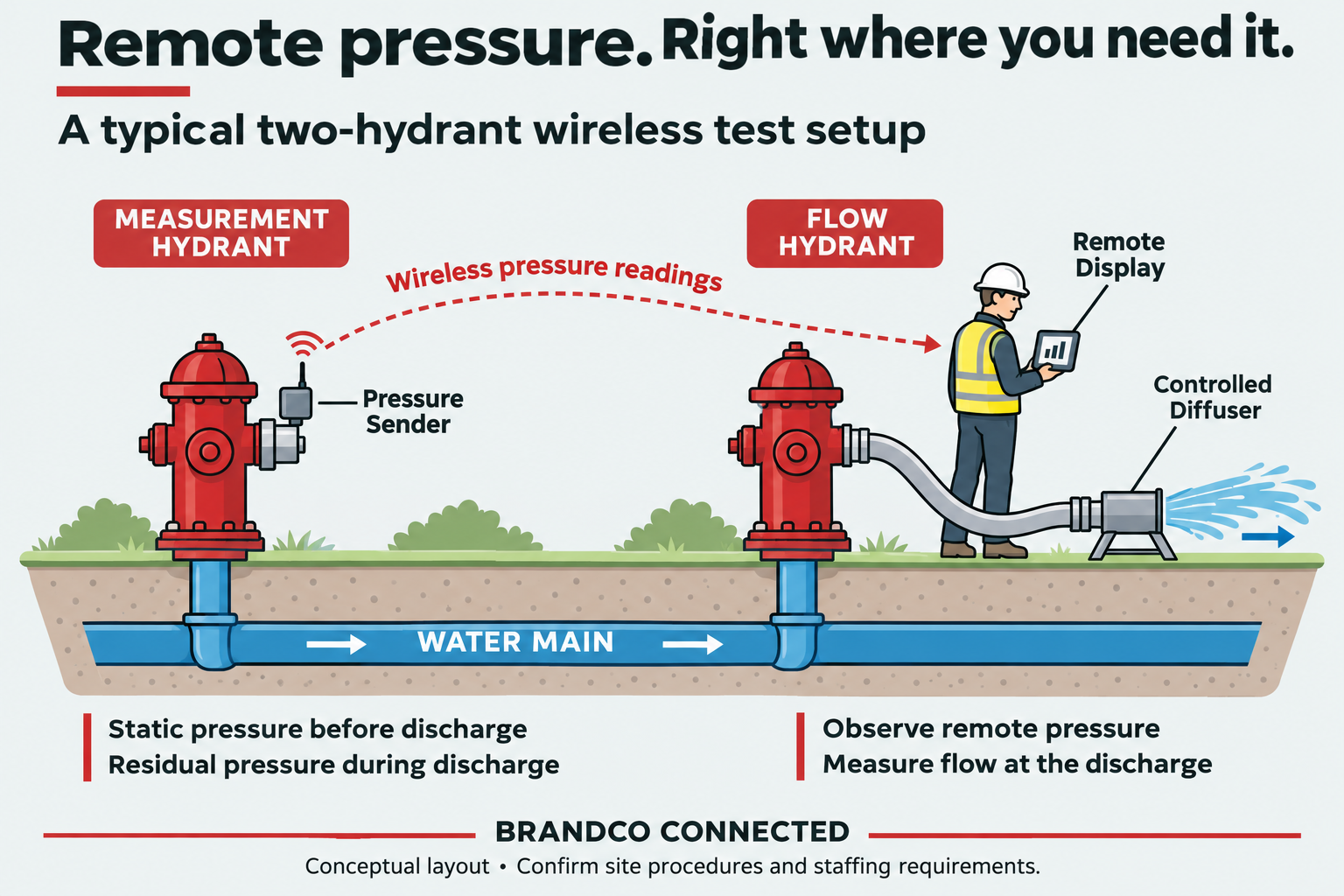
Bring remote pressure readings to the person controlling the flow. Brandco connects a Pressure Sender at the test hydrant to a Remote Display in your hand.

UNDERSTAND THE TEST
Three readings. One clearer picture.
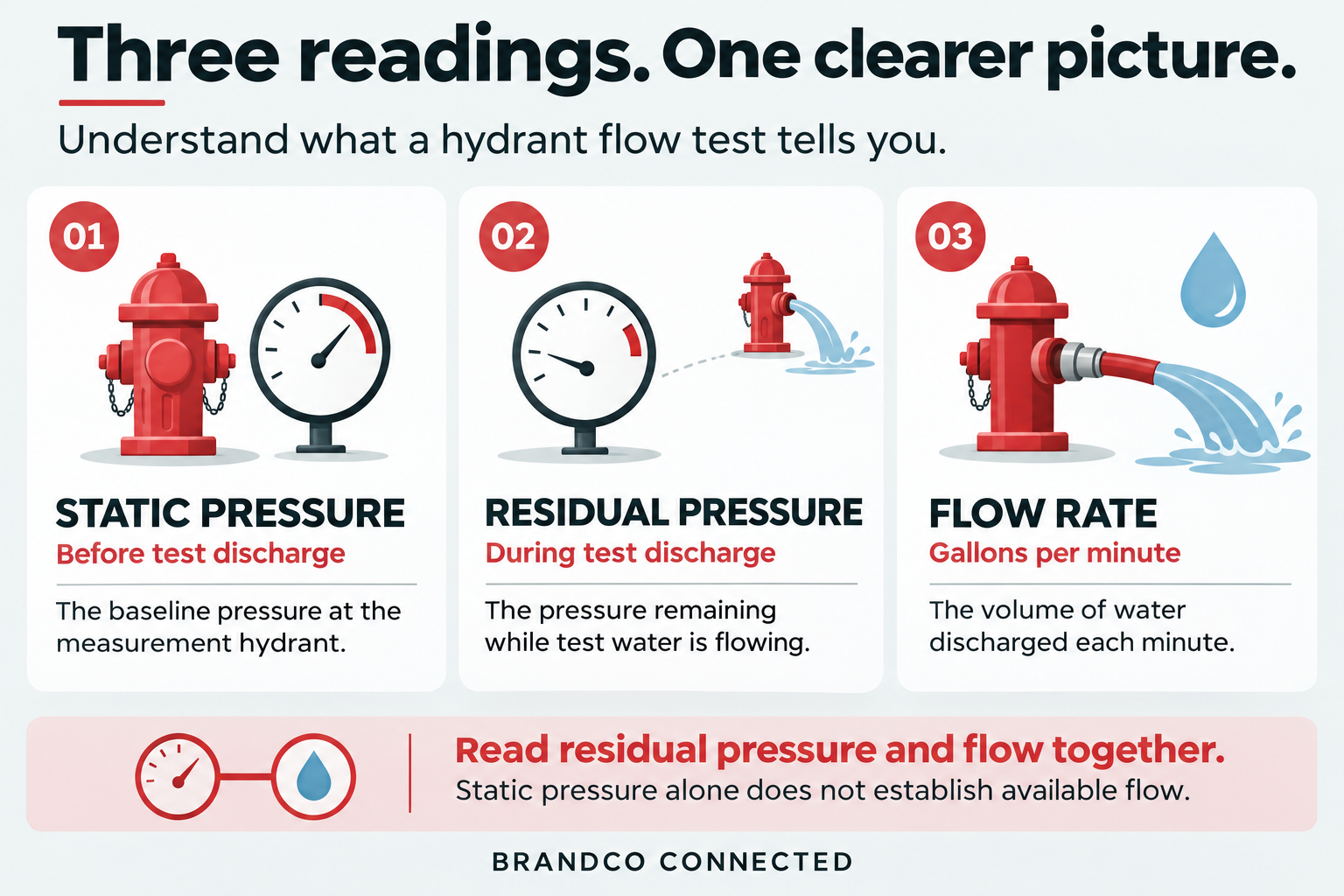
A hydrant flow test brings together static pressure before test discharge, residual pressure while water is flowing, and flow rate—the volume discharged each minute. Together, they help professionals evaluate the water supply available under the conditions of the test.
These tests support fire-protection planning, water-supply evaluation, and investigation of distribution-system performance. Results are a snapshot: system demand, valve positions, and other conditions can affect the readings.
THE WIRELESS ADVANTAGE
Traditional Hydrant Flow Testing
vs Wireless Testing
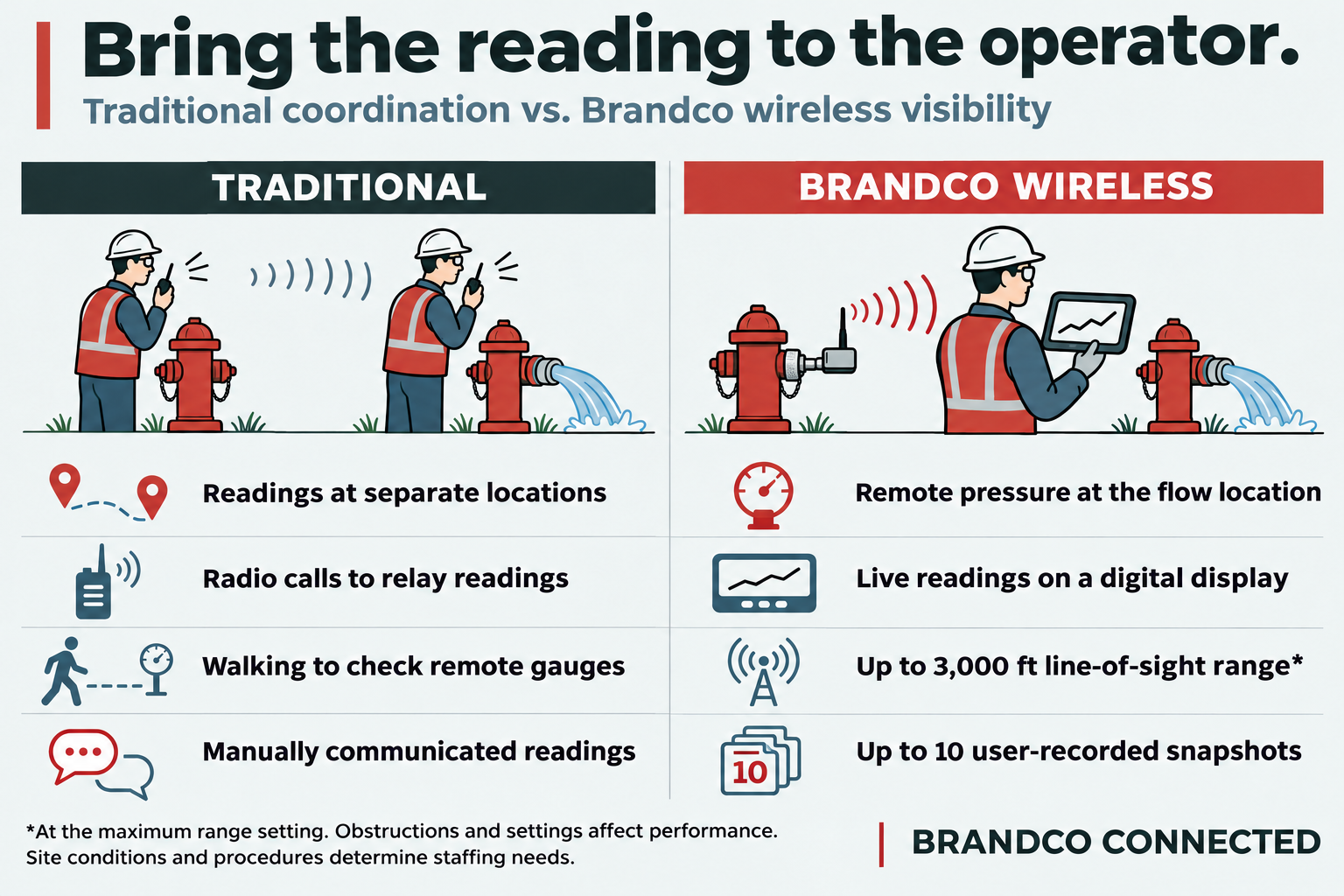
When pressure and discharge are measured at different locations, coordinating readings becomes part of the job. Brandco makes that information visible where the operator needs it.
BUILD THE RIGHT SETUP
Equipment Needed for a Hydrant Flow Test
A complete setup measures pressure, determines discharge flow, and manages the water safely.
Pressure measurement
A suitable test cap and pressure instrument at the static/residual measurement point. Add a Brandco Pressure Sender and Remote Display for wireless visibility.
Flow measurement
An appropriate pitot arrangement, calibrated nozzle, or compatible flow device, with the correct settings or data needed to determine gallons per minute.
Connections, discharge & documentation
Suitable hoses, adapters, valves, a diffuser where required, and a hydrant wrench. Include the site’s required protective equipment, traffic controls, and discharge provisions. Document readings, locations, instrument details, and test conditions.
Browse hydrant test sets → Explore the Pressure Sender Mini →
Single-Person Hydrant Flow Testing
Keep the pressure reading beside the operator.
Attach a Pressure Sender to the static/residual hydrant’s compatible test-cap connection. Carry the Remote Display to the flow location. You can observe remote pressure while controlling discharge and measuring flow with your existing equipment.
One sender provides remote pressure visibility. Add a second at a compatible flow-device gauge port to bring pressure and calculated GPM onto the same display. A third sender adds another measurement point when the test layout calls for it.
Wireless visibility reduces the coordination needed to obtain readings from separate locations. Single-person capability does not eliminate additional staffing required for traffic control, safe discharge, or site procedures.
Explore the Water Supply Test set →
ANSWERS BEFORE YOU TEST
Frequently Asked Questions
Can one person conduct a hydrant flow test?
Brandco lets one technician observe remote pressure while working at the flow location. Whether one person can perform the entire job depends on the site, discharge arrangement, and required procedures.
Does wireless testing mean using only one hydrant?
No. The number and arrangement of hydrants depend on what the test is intended to establish. Wireless equipment lets the operator see readings from separate locations.
How far can the wireless equipment transmit?
Up to 3,000 ft line of sight at the maximum range setting. Buildings, equipment, and other obstructions can reduce range. Verify communication at the test locations before beginning; update speed depends on the selected range setting.
Can I use Brandco with my existing equipment?
Check the connection, pressure range, and flow-measurement method for your equipment. The Pressure Sender Mini uses a 1/4-inch NPT quick-connect arrangement. Compatible flow devices require the correct diameter and coefficient settings for calculated GPM.
Does a Pressure Sender measure GPM directly?
It measures pressure. With flow calculation enabled, the Remote Display uses the appropriate flow-device settings to calculate GPM. Static or residual pressure alone is not a substitute for a flow measurement.
Can I save test readings?
The Remote Display supports up to 10 user-recorded pressure/flow snapshots for recall. Include those readings in your complete test documentation alongside locations and test conditions.
How often should hydrant flow testing be performed?
Confirm the interval with the water authority or authority having jurisdiction and the requirements adopted for your system. Public water-supply evaluation and private fire-service maintenance can involve different schedules and purposes.
Which set should I start with?
Choose a single-sender set for remote pressure visibility. The Water Supply Test set adds a hydrant test cap. Choose two or three senders when you need readings from additional measurement locations.
FIND YOUR WIRELESS SETUP
Hydrant Testing Equipment
Start with remote pressure visibility. Add senders as your test layout grows.
Explore all hydrant test sets → Ask Brandco about your setup →
01 REMOTE PRESSURE
Basic Remote Water
Pressure Gauge set
One Pressure Sender, a Remote Display, and a carrying case. Add wireless pressure visibility to a compatible existing setup.
02 HYDRANT-READY CONNECTION
Water Supply
Test set
A single-sender setup with a Remote Display and a 2.5-inch NH/NST hydrant test cap. Bring the pressure reading to the flow location.
03 PRESSURE + CALCULATED FLOW
Dual Wireless Water
Pressure Gauge set
Two senders and one display for remote pressure plus compatible flow-device readings. See the measurements together.
04 ANOTHER MEASUREMENT POINT
Triple Wireless
Pressure Gauge set
Three senders and one display for test arrangements that need another measurement location. Configure each sender for the work.
Testing Terminology
Static vs Residual Pressure
Static pressure · Before discharge
The pressure measured before water is discharged for the test. It is the baseline for comparison.
Residual pressure · During discharge
The pressure remaining at the measurement location while test discharge occurs. Comparing it with static pressure shows the pressure change associated with that flow.
Flow rate · Gallons per minute
The volume discharged each minute, determined using an appropriate flow-measurement method. High static pressure alone does not establish available flow. A useful test record connects static pressure with simultaneous residual-pressure and flow readings.
Hydrant Testing Standards and Frequency
NFPA 291, Recommended Practice for Water Flow Testing and Marking of Hydrants, provides guidance on flow testing and hydrant marking. AWWA M17 addresses hydrant installation, field testing, and maintenance. NFPA 25 also applies to inspection, testing, and maintenance of private fire-service systems within its scope.
The required schedule depends on the system, test purpose, adopted requirements, and water authority or authority having jurisdiction. Routine inspection, flushing, and a water-supply flow test serve different purposes. Confirm the applicable edition and interval before scheduling work.